The data behind how are kids attending school?

These are indeed strange times filled with hard choices. I don’t envy any parent, employer, teacher, school board member, etc. any of the choices they are having to make. Pile on top that the “volume” of these conversations has been turned up to 11 by our current political climate, and any choice can feel very isolating. But it turns out… none of us are isolated.

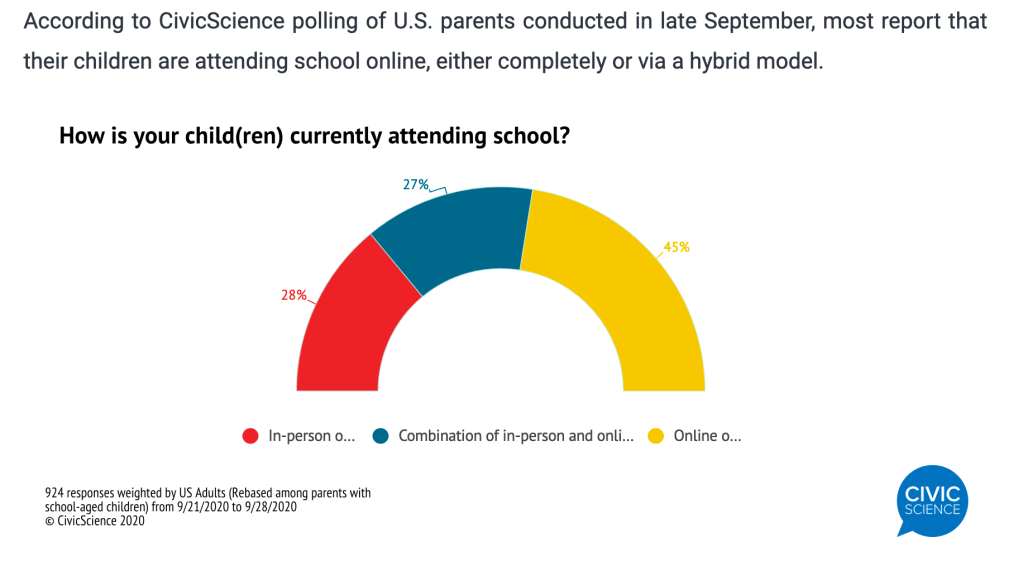
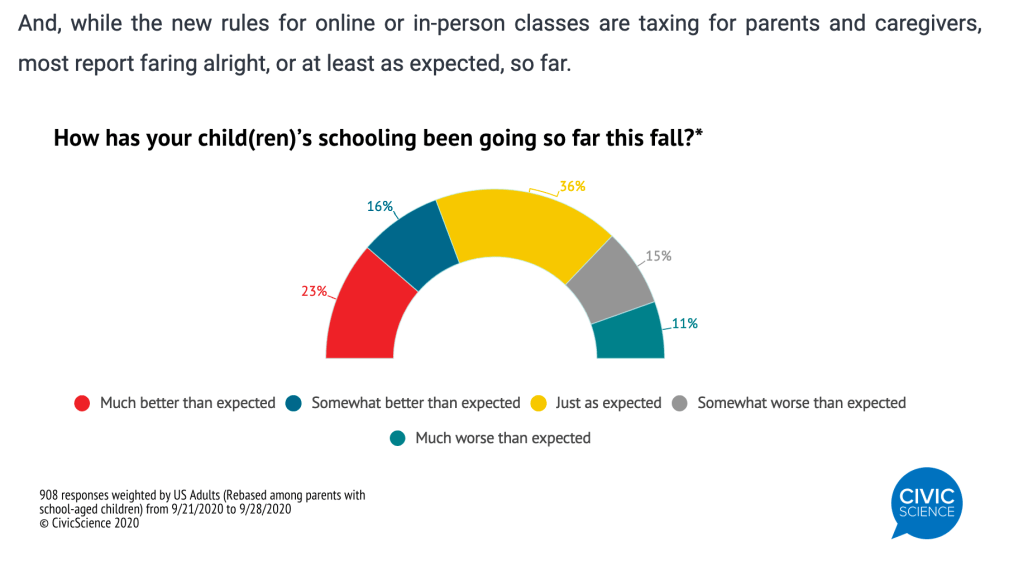
The group Civic Science reports key findings from extensive surveys completed each week. They focus on many different behaviors and choices during the COVID crisis, but I found the data on schools interesting in that, while none of this is perfect (which I can testify to as part-time Home Online 4th Grade Monitor), it’s not all bad either. Many different choices are being made and most people report decent satisfaction with those choices. I call out a few of the numbers on schools below, but the entire report from this week can be found here. Happy reading!
Navigating COVID-19 Stress in the Workplace

As part of my job I sit on a number of boards of directors and this week I had four board meetings (NOTE: Who’s in charge of scheduling around here?!?!). A theme in every single one of those meetings this week was the fatigue and stress employees are experiencing due to stresses, both work and personal, brought on by the variety of life changes induced by COVID-19. There’s no question that most people’s lives are materially different at work and at home: inability to travel, lackluster technology, closed offices, closed schools, spouses/partners/kids at home, reduced opportunities to socialize. The list is long. In my view, “We” are not dealing with these stress inducers.

Unfortunately, there are no magic answers for these issues, but below are a few resources that you might find helpful in helping your employees, co-workers, family members, or kids deal with COVID-19 induced stress.

From the CDC on coping with job stress – Lot’s of helpful links and hotlines at the bottom.

From the CDC again on designing healthy work environments.

From the American Psychological Association with LOTS of links and data related to parents and people of color.

From Deloitte on practical strategies to help employers take care of employees.

This is a short list of great resources and links, but I know there are more. What resources are you relying to help deal with workplace stressors in the time of COVID-19? Let us know in the comments.

Well, if billionaires are talking about it…

There is a lot of talk about the rapidly widening economic gap between the very very wealthy and the rest of the population. It’s an important conversation and something that needs desperately to be addressed in my opinion. There’s lots of great stuff out there to be read on the subject. One of my favorites is this one from mid-2018 in The Atlantic. Another is this piece from, of all places, Mckinsey & Co, on the impact of the wealth gaps that exist among people of different races in the US. But we’ve reached a whole new level now… because billionaires are talking about.

Two interesting points of view. This interview from Marketwatch with Ray Dalio is interesting. I’m not much of a Ray Dalio fan for a variety of reasons, but he has become an interesting voice in the billionaire wilderness advocating for substantial changes to how the world economy, and capitalism in particular, treats everyone.

Perhaps more interesting though, is this interview with entrepreneur and investor Nick Hanauer. Nick has been flying the inequality flag for some time, but in this episode of The Ted Radio Hour, he speaks about how we begin to rewrite our contracts with each other and with capitalism to the benefit of all. It starts at the 40:15 mark (though this whole episode is great).

It’s my belief that the widening gap between those that have and those that don’t is one of the most challenging we face in the near future. And if billionaires are talking about it…

The Magic Formula

I frequently get asked some version of the following: “What’s the best way to answer when a venture capitalist asks ____________________?” Depending on my mood that day, I usually start my answer with some version of snark directed at my general profession. But on my more generous days, I refer people to this answer provided by Alex Dunsdon.

When building a rapid growth business – one that is trying to attract venture capital dollars – the reality is chaos. Nearly permanent chaos. Even when things are “going well,” the sheer tonnage of what you don’t know about your customers, about your product, about the five people you just hired, all of whom went through different onboarding (whoops!) is staggering. So you play a magic trick by starting with what you DO know and append to that how the knowledge you’ve earned informs your next actions, thus how you will spend the VC’s money. Provide certainty about your PROCESS because it may be all you’ve got. I don’t care what VCs tell you about how much risk they take or the “big ideas” they love or whatever other BS is being spouted on Twitter, VCs prize anything they can latch on to with confidence. When you have little worth hitching up, this is a path to creating it. As Alex goes on to say…

“This is part of my general thesis that your job as a founder is to present ‘certainty’ where there is none. Hence you create certainty around your process and assumptions…”

-Alex Dunsdon

Like magic…

Today’s reading recommendation is The Storm Before The Storm by Mike Duncan. It’s the story of the 100 years or so before the fall of the Roman Empire. It’s instructive. You’ll recognize some patterns. Patterns worth being aware of. I’m sure you can buy it other places, but I prefer to get my books from bookshop.org. So you can find it here.

The Return of the Blog

Against my better judgment, but with the encouragement of others (you know who you are and you are to blame), I’ve decided to revive the Mountain Palaver! And so we shall proceed with some semi-regular musings about venture capital, start-ups, entrepreneurs, a dabbling of (GASP!) politics and frequent recommendations for things to read, listen to or watch.

We’ll start small this week and go with a listening recommendation – the “Motive” podcast. “Motive” is produced by WBEZ Chicago. I highly recommend Season 3 which tracks in detail the rebirth of the White Supremacist movement in the 1980s and 1990s in the form of neo-Nazi skinheads. I find this story important context for some of the things we are hearing and seeing today. It can be difficult to listen to, so be advised. You can find Motive lots of places, like the NPR website, Apple Podcasts, or Spotify. Episodes are released weekly.